
The Cosmic Octave
Overview
The Cosmic Octave describes a principle by which periodic processes in nature and the cosmos can be translated into audible frequencies and visible colors through octaving — from astronomical cycles to molecular vibrations.
The starting point is a simple ratio: In music, the octave is a fundamental principle of resonance. When this ratio is applied to other levels of vibration, specific frequencies emerge that can be represented as sound or color.
The principle was formulated in 1978 by Hans Cousto and integrates astronomical, physical, and musical relationships into a unified model.
Planetware has been documenting the development of the Cosmic Octave ever since.
Basics

The Cosmic Octave makes it possible to translate very slow cycles or very high frequencies into the range of sensory perception via the octave. In this way, these rhythms can be experienced and utilized as sounds or colors.
Tuning into Nature's Cycles

Astronomical and physical cycles can be translated into audible frequencies through octaving.
From galaxies to cells, vibrations and recurring patterns of movement can be observed everywhere. A central principle is resonance: vibrations can amplify one another, harmonize, or generate new dynamics.
The cycles of the Earth, Moon, and planets shape time, movement, and life. The alternation of day and night influences biological rhythms, while the Sun’s annual path governs natural processes.
When these cycles are translated into the audible range, they can be experienced as sound and music.
Tuning means selecting frequencies that resonate with natural cycles.
Hans Cousto and the Cosmic Octave
In 1978, the Swiss mathematician and musicologist Hans Cousto recognized that the octave law — the doubling of frequency — can also be applied outside the realm of music.

By repeatedly doubling or halving a frequency (f · 2ⁿ), temporal processes can be translated into the audible range.
The octave is based on acoustic principles: A sound consists of overtones, the first of which has twice the frequency of the fundamental tone. This ratio forms the basis of harmonic resonance.
Based on this principle, Cousto converted the orbital and rotational periods of the Earth, Moon, and planets into frequencies and derived corresponding tones.
As a first step, he calculated the tone of the Earth’s rotation.
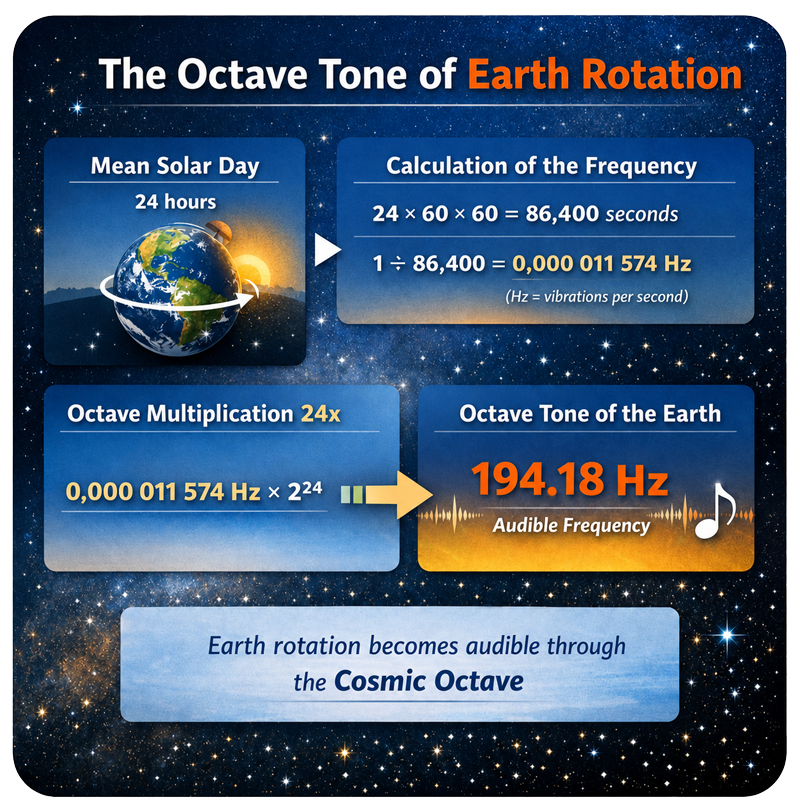
The resulting sound corresponds to this natural cycle within the audible range. Cousto later applied this principle to planetary movements, colors, molecules, and other levels of vibration.

Further Information
Detailed information on frequencies, applications, and Hans Cousto's work is available on the German-language website:
→ Visit Planetware (German)
You can find all the information about the frequencies and possible applications in the menu
→ Frequenzen (frequencies)
→ Anwendungen (applications)
You can use automatic translation if needed.
Planetary Tuning Forks
Tuning forks based on planetary frequencies are available in the Planetware shop:
→ shop.planetware.de/en
More background information:
→ Planetware
→ Cosmic Octave
→ Tuning forks
→ Sonopuncture
Where to buy in Australia and the Netherlands
→ Wind Chimes Australia
→ Magna Mater, Netherlands
Publications by Hans Cousto
The brochure The Cosmic Octave Tuning Forks is available as a PDF:
→ PDF
The book Die Oktave was published in English as
The Cosmic Octave – Origin of Harmony:
→ LifeRhythm, USA
Bilingual publication (1980):
Farbton Tonfarbe und die Kosmische Oktave –
Relating Sound to Color and the Cosmic Octave
→ Facsimile (PDF)